The KIIS Is Where Due Diligence Begins. Not Where It Ends.
· Due Diligence
Why independent investor research must go beyond official crowdfunding disclosures - and why AI alone will never be enough.
*Why independent investor research must go beyond official crowdfunding disclosures - and why AI alone will never be enough.*
European equity crowdfunding has come a long way in making investment opportunities accessible to retail investors. Under the EU Crowdfunding Regulation (ECSPR), investors benefit from a harmonised disclosure framework, including the Key Investment Information Sheet (KIIS).
The KIIS is an important document. It gives investors a structured introduction to the company, the offering, its financial position, and the principal risks associated with the investment.
But there is a fundamental distinction that deserves more attention.
**Understanding what a company has disclosed is not the same as independently investigating the risks of investing in that company.**
That distinction is at the heart of independent due diligence.
A Disclosure Document Is Not an Independent Investigation
Under ECSPR, the KIIS is prepared under the responsibility of the project owner. Crowdfunding service providers are required to maintain procedures for checking the completeness, correctness and clarity of the information provided.
Article 5 of ECSPR also establishes minimum due diligence requirements concerning project owners, including specified checks relating to criminal records and jurisdictions. These requirements should not be confused with a comprehensive commercial, financial or operational assessment of an investment opportunity.
These are important investor protections. They do not, however, transform the KIIS into an independent investment assessment.
A company's financial projections may be clearly presented, but are the underlying assumptions realistic? Its management team may have substantial experience, but what does its actual track record reveal? A growing market may offer significant opportunities, but how does the company compare with existing competitors?
And perhaps most importantly, what relevant risks have not been addressed in the offering materials at all?
None of these questions necessarily suggests that the company or the crowdfunding platform has done anything wrong.
They simply reflect the difference between disclosure and investigation.
A well-prepared KIIS can be accurate, consistent with the applicable regulatory framework and complete within its required scope, while still leaving investors with legitimate questions about the underlying business.
This is especially important in early-stage investing, where information asymmetry is inherent. Company founders and management generally know considerably more about their business than prospective outside investors.
Regulatory disclosure helps reduce that asymmetry. It does not eliminate it.
Why AI Analysis of the KIIS Is Only the First Step
Artificial intelligence is changing how quickly investors can process information.
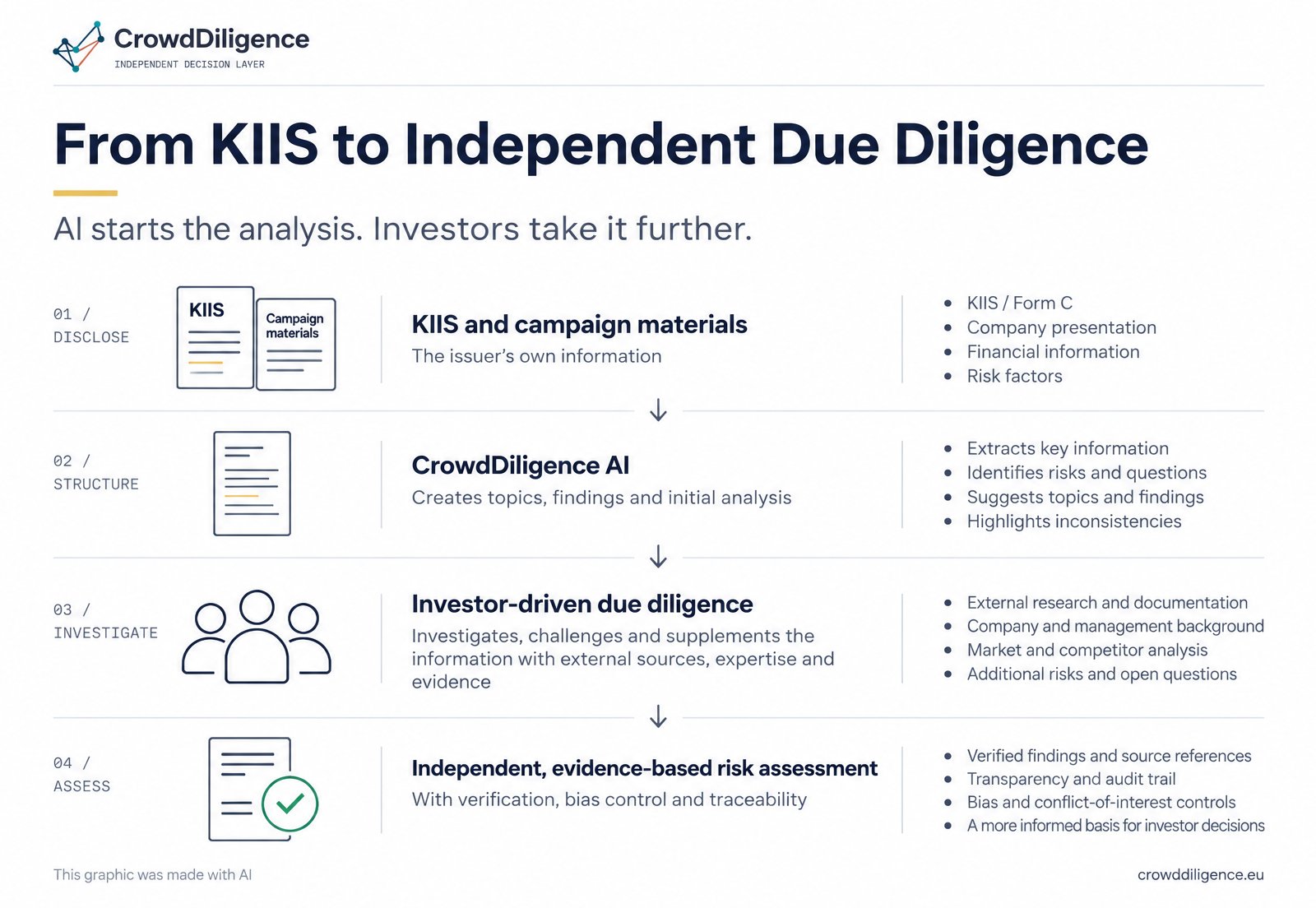
An AI system can read a lengthy KIIS, extract financial figures, identify potential inconsistencies, organise risk factors and generate structured questions in a fraction of the time a manual review would require.
That is valuable. But it is not the same as completing due diligence.
An AI system working exclusively from the issuer's documents remains constrained by those documents. It may identify inconsistencies within the narrative, but it cannot establish the full picture simply by analysing the information it has been given.
If an important competitor is missing from the market analysis, if a management team's previous business activities raise relevant questions, or if external market developments challenge the company's assumptions, those issues may never emerge from a document-only review.
Even a technically accurate AI-generated analysis can therefore provide an incomplete picture.
AI can help investors recognise what deserves further investigation. But the investigation itself requires additional evidence, critical judgment and, frequently, expertise from outside the original investment materials.
**The real opportunity is not to replace investor due diligence with AI. It is to make independent due diligence more accessible, structured and collaborative.**
The Missing Layer: Investor-Driven Investigation
This is the distinction we are building around at [CrowdDiligence](https://crowddiligence.eu).
Our approach starts with the official investment documentation. For European crowdfunding offerings, that means the KIIS. For US Regulation Crowdfunding offerings, it means the SEC Form C and its associated disclosures.
AI-assisted analysis helps structure the initial research into due diligence topics, findings and preliminary assessments.
But that is only the foundation.
Investors can examine a company's financial assumptions, investigate the management team's background, compare market projections against independent research, identify legal or commercial risks, and introduce evidence that was never part of the original campaign documentation.
They can also scrutinise the disclosures themselves.
Are the financial projections internally consistent? Do historical figures support the growth assumptions? Are the stated risks sufficiently specific to the company? Are important claims supported by identifiable evidence?
These are questions that can arise directly from the KIIS.
Other questions only emerge when investors look beyond it.
A company's market position, competitive environment, management history and operational dependencies may require research using company registers, financial statements, market reports and other external sources.
Other contributors can introduce additional evidence, identify contradictions or offer different interpretations of the same information.
Assessments are supported by documented reasoning and available evidence, including external research and supporting documents, while AI-assisted contributions remain subject to human verification.
The objective is not simply to reproduce the company's investment narrative in a different format. It is to subject that narrative to independent scrutiny and investigate relevant questions that the narrative may not address.
The resulting due diligence assessment is therefore more than an AI-generated summary of an investment opportunity.
It represents a developing body of investor research, where assumptions can be examined, information can be challenged and different perspectives can contribute to a more complete understanding of the investment case.
Why the Crowd Matters More Than the Algorithm
The term *crowd intelligence* is often used rather loosely.
Simply collecting opinions from a large number of investors does not necessarily produce better conclusions.
James Surowiecki's *The Wisdom of Crowds* (2004) popularised the idea that collective judgments can outperform individual expertise under certain conditions. But those conditions matter. Diversity of perspectives, independence of judgment, decentralised knowledge and effective aggregation are central to the argument.
Without them, the crowd can just as easily reinforce existing assumptions.
Crowdfunding markets are particularly exposed to information cascades, social proof and the tendency to interpret investment momentum as evidence of investment quality.
A campaign attracting substantial funding may be commercially promising. But the amount already invested tells us relatively little about the validity of its financial forecasts, the strength of its intellectual property or its ability to execute its business plan.
There is also a collective action problem.
Research by Coakley, Cumming, Lazos and Vismara (2024), examining syndicated equity crowdfunding, highlights challenges associated with coordinating investors, due diligence costs and free-riding.
The implications extend beyond syndicated investments.
Independent research requires time, expertise and resources. Individual investors may benefit from someone else's investigation without contributing themselves. Conversely, highly active participants may disproportionately influence the collective assessment.
This creates a fundamental design challenge for collaborative due diligence platforms.
How do we encourage useful contributions without confusing activity with expertise? How do we recognise valuable research while reducing the influence of personal financial interests? And how do we prevent collective analysis from becoming a mechanism for reinforcing the crowd's existing enthusiasm?
At CrowdDiligence, we are developing our methodology around these challenges.
Individual assessments are connected to specific findings and documented reasoning. Potential conflicts of interest can be flagged by administrators and reflected in the weighting of contributions. AI-assisted assessments remain distinguishable from human contributions and are subject to human verification before approval.
These mechanisms are intended to support more transparent and accountable analysis. They do not guarantee that collective judgments will be correct, and the effectiveness of CrowdDiligence's methodology has not yet been established through independent empirical research.
The aim is not to manufacture consensus. It is to make different assessments and their underlying reasoning visible.
One investor may consider a company's growth assumptions credible. Another may find evidence that challenges those assumptions. A third may contribute specialist knowledge of the relevant market.
The value is not that these investors necessarily reach the same conclusion.
**It is that their reasoning becomes available for examination rather than disappearing into an average score or an investment decision made in isolation.**
An Independent Layer, Not a Replacement for Crowdfunding Platforms
There is an important implication for crowdfunding platforms themselves.
Independent investor research should not be interpreted as a criticism of the platform's existing due diligence or regulatory procedures.
Platforms and independent investors perform different functions.
A crowdfunding service provider operates within a regulatory framework that defines its responsibilities towards project owners and investors.
Independent due diligence asks additional questions about the investment case, drawing on information, expertise and perspectives that may extend well beyond mandatory disclosures.
These functions can complement one another without becoming interchangeable.
A platform can fulfil its regulatory obligations while investors still have legitimate reasons to investigate the commercial viability, management capabilities, financial assumptions or competitive position of a particular company.
Indeed, the value of independent analysis may be greatest when it remains genuinely independent, including the ability to identify weaknesses in campaigns that have already passed a platform's admission procedures.
That independence must be maintained regardless of whether the analytical service obtains campaign information directly from a platform or through other legitimately accessible sources.
Access to reliable, structured campaign data can make independent investor research more efficient. It must never give an intermediary influence over the analytical conclusions.
For crowdfunding platforms, this creates an opportunity to support an additional layer of investor transparency without transferring their regulatory responsibilities or controlling the independent research process.
Whether such arrangements ultimately improve investor outcomes is an empirical question, not something that should be assumed.
Better Information Does Not Guarantee Better Investments
There is one final distinction worth making.
More due diligence does not eliminate investment risk.
A company may provide excellent disclosure, demonstrate strong management capabilities and operate in an attractive market, and still fail.
Early-stage equity investments remain inherently uncertain and frequently illiquid. Investors may lose their entire invested capital.
Nor should a due diligence score be confused with a forecast of investment returns.
It is important to distinguish between three related but fundamentally different concepts.
**Disclosure quality** concerns the completeness, clarity and evidential support of the information available to investors.
**Underlying investment risk** concerns the financial, commercial, operational, governance and other uncertainties associated with the company and the investment.
**Investment attractiveness** is ultimately an investor-specific judgment involving valuation, expected returns, risk tolerance, investment horizon and portfolio considerations.
A company can disclose serious financial difficulties with exceptional transparency. The quality of its disclosure may be high even when its financial risks are substantial.
Conversely, an incomplete disclosure does not automatically mean that the underlying business is commercially unattractive. It means investors face additional uncertainty.
CrowdDiligence uses a structured assessment methodology to evaluate disclosed information, supporting evidence and documented findings. Its resulting score should not be interpreted as a prediction of investment performance or as a recommendation to invest.
These distinctions matter because the purpose of independent due diligence is not to manufacture certainty where none exists.
It is to help investors understand what is documented, what remains uncertain, which assumptions deserve further investigation and where the available evidence supports competing interpretations.
That may not always produce a simple answer.
But a well-documented uncertainty is considerably more useful than a confident conclusion built on incomplete information.
From Access to Independent Judgment
Equity crowdfunding has made it easier for ordinary investors to access investment opportunities that were once largely reserved for professional networks and institutional capital.
The next challenge is to make independent analysis more accessible as well.
KIIS documents, SEC filings and other official disclosures are essential parts of that process. AI can make those documents easier to examine. Collaborative research can extend the investigation beyond their boundaries.
But informed investment decisions ultimately depend on something neither regulation nor automation can deliver alone: critical, independent judgment supported by evidence.
The opportunity is not merely to build faster tools for reading investment documents.
It is to create an environment where investors can examine the claims, challenge the assumptions, contribute their own research and understand the reasoning behind the assessments they encounter.
**The KIIS is where due diligence begins. It should never be where curiosity ends.**
---
References and Further Reading
- European Parliament and Council (2020). *Regulation (EU) 2020/1503 on European crowdfunding service providers for business.* In particular, Articles 5 and 23. [EUR-Lex](https://eur-lex.europa.eu/eli/reg/2020/1503/oj)
- Surowiecki, J. (2004). *The Wisdom of Crowds: Why the Many Are Smarter Than the Few and How Collective Wisdom Shapes Business, Economies, Societies and Nations.* Doubleday.
- Coakley, J., Cumming, D., Lazos, A. & Vismara, S. (2024). *Syndicated Equity Crowdfunding and the Collective Action Problem.* ECGI Finance Working Paper No. 955/2024. [ECGI](https://www.ecgi.global/publications/working-papers/syndicated-equity-crowdfunding-and-the-collective-action-problem)
- CrowdDiligence. *White Paper - Methodology, Investor-Driven Research and AI Governance.* [Read the White Paper](https://crowddiligence.eu/whitepaper)
---
*CrowdDiligence is an independent, AI-assisted, investor-driven due diligence platform covering European equity crowdfunding and US Regulation Crowdfunding. Its analyses are intended to support informed investor research, not to provide personalised investment advice or predict investment returns. Equity crowdfunding involves substantial risk, including the potential loss of all invested capital.*
Tags: KIIS, ECSPR, equity crowdfunding, due diligence, investor protection, AI governance, independent research